
Import & Trade
Alipay vs WeChat Pay: What Nigerian Traders Should Know Before Paying China
Raiz Editorial·Last updated ·8 min read
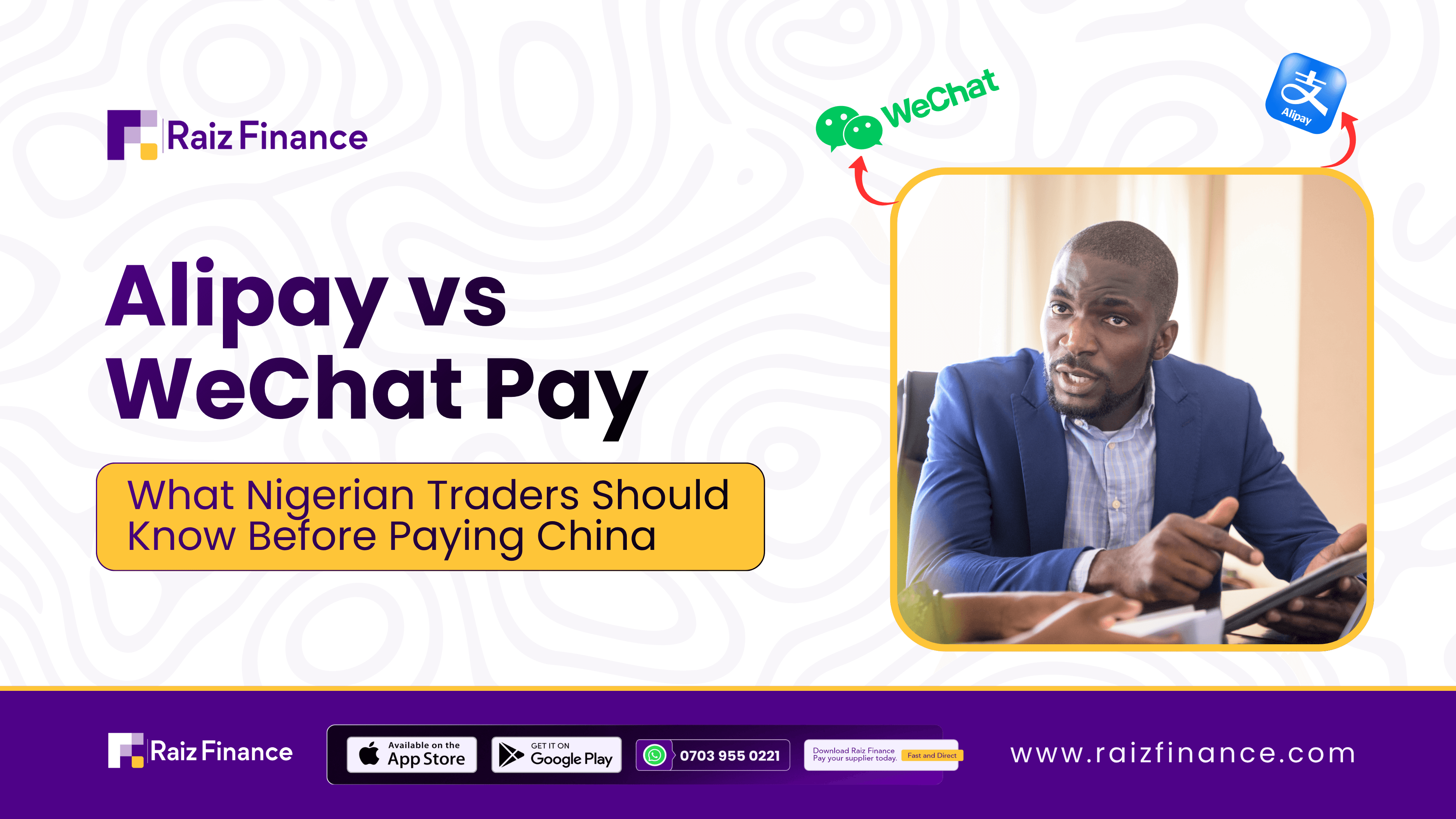
If you are sourcing from China, you have probably already run into this: the invoice arrives, and instead of an account number, you get a QR code. Sometimes it says Alipay. Sometimes it says WeChat Pay. Two of the most common payment apps a Nigerian trader will need, but which one do you actually need for this order?
Both apps make paying a supplier fast in theory, but the scenario and the supplier you are dealing with are what actually decide between them. Alipay tends to be the better fit if you are sourcing directly from Taobao or 1688. WeChat Pay is usually the one your supplier expects if you are dealing with a smaller factory or an agent who quotes you over chat.
There is very little either app does to solve the part that actually slows Nigerian traders down: getting Naira into either wallet quickly and without losing money to conversion markups or a card decline. So most traders sourcing regularly from China also set up a Raiz Finance account to fund one wallet in Naira and pay whichever QR code their supplier sends.
What is Alipay?
Alipay is China’s largest digital payment platform, run by Ant Group. It launched in 2004 and has grown into a full financial ecosystem used by over a billion people, covering everything from in-store QR payments to bill settlement, transport, and online shopping through Taobao and 1688, the two platforms most Nigerian traders source from.
Can Nigerian Traders Use Alipay?
Yes. Alipay allows foreign users to register with an international Visa or Mastercard, without needing a Chinese bank account or a Chinese SIM card. You sign up with your Nigerian phone number, upload your passport, complete a facial verification, and link your card. For most users, verification clears within a few hours.
What Is WeChat Pay?
WeChat Pay is Tencent’s payment feature, built directly into WeChat, the messaging app almost every business contact in China already uses. It launched in 2013 and grew around social habits first (red packets, group transfers, chat-based payments) before becoming a serious commerce tool for merchants and small suppliers.
Can Nigerian Traders Use WeChat Pay?
Yes, on the same basis as Alipay. You register with your home phone number, link an international card, upload your passport, and complete facial verification. The difference is speed. WeChat Pay’s review process tends to take longer, sometimes a few days, and can require manual checks, so it is worth setting up well before you need to pay anyone urgently.
Alipay vs WeChat Pay: What Is the Real Difference?
Ant Group, the Chinese fintech company that owns and operates Alipay, has been clear that the two apps are not built to be direct competitors. Alipay is organised around payment and financial management. WeChat Pay is organised around social connection, with payment as a feature inside it. That distinction matters more than most comparisons let on, because it decides which app your supplier actually expects you to use, and how each behaves once your order volume grows.
Alipay vs WeChat Pay Feature Comparison
| What you are doing | Alipay | WeChat Pay |
|---|---|---|
| Sourcing on Taobao or 1688 | Native and built-in | Not supported |
| Paying a small factory or agent | Works, but less common in trade circles | Preferred by most small suppliers |
| English language interface | Fully in English | Partial, mixed with WeChat’s Chinese UI |
| Verification time for foreign users | Usually within hours | Often one to three days |
| Splitting or sending money in a group | Clumsy | Built for this |
| Confirming an agent’s identity before payment | Harder, purely transactional | Easier, tied to an existing chat history |
| Reordering from a supplier you already paid | Saved payment history in app | Buried inside chat threads |
Fees and Limits You Should Budget For
Both apps use roughly the same fee structure for foreign verified users, so cost is not really what should decide between them. Purchases under about 200 RMB typically carry no platform fee. Above that, a service fee of around 3 percent applies, on top of whatever foreign transaction fee your home bank charges separately.
Transaction ceilings are the part traders get caught out by, and the figures published online are inconsistent because China’s central bank raised the regulatory ceiling for verified foreign card users in 2024.
In practice, most freshly verified foreign accounts still show a per-transaction cap in the 5,000 to 6,500 RMB range with an annual cap somewhere in the tens of thousands of RMB, even though the higher regulatory ceiling (equivalent to roughly 5,000 dollars per transaction and 50,000 dollars a year) exists for accounts with full verification history.
Treat the lower figures as the safe planning number and confirm the actual cap shown in your own app before committing to a large order.
This is where trading volume becomes a real problem. A single container order or a bulk supplier payment can blow past those limits in one transaction, forcing you to split payments across days, which slows down clearance and creates awkward back-and-forth with suppliers who just want to see the full amount land.
Fee and Limit Comparison
| Fee / Limit Type | Alipay | WeChat Pay |
|---|---|---|
| Fee under 200 RMB | None | None |
| Fee above 200 RMB | Around 3 percent | Around 3 percent |
| Typical per-transaction cap | 5,000 to 6,500 RMB | 5,000 to 6,500 RMB |
| Typical annual cap | Tens of thousands of RMB | Tens of thousands of RMB |
| Verification time | Usually hours | Often one to three days |
Can You Move Money Between Alipay and WeChat Pay Directly?
No. There is no direct transfer between the two wallets. If you need funds in both, each one has to be funded separately, usually from the same linked card, which just multiplies the card decline risk and the conversion markups traders are already trying to avoid.
Where Alipay and WeChat Pay Fall Short for Nigerian Traders
Neither app was built with Nigeria in mind. Both expect you to fund your wallet from an international card, usually billed in dollars or another foreign currency, which means your Naira has already gone through one or two layers of conversion, and your bank’s own fees, before it even reaches the app. Add card declines from unfamiliar foreign activity, unpredictable exchange rates on your statement, and transaction ceilings that do not match real trade volumes, and the process becomes expensive and unreliable exactly when you need it to be fast.
This is the actual pain point for Nigerian traders. Not choosing between Alipay and WeChat Pay, but getting Naira into either one without losing money to conversion markups or waiting days for a card payment to clear.
How Raiz Finance Solves This
Raiz Finance connects directly to both Alipay and WeChat Pay, so you never have to open a separate account with either app or gamble on a foreign card getting approved. You fund your Raiz account with Naira, and from there you can pay any Alipay or WeChat Pay QR code straight from the platform, at a transparent rate, with a record you can use for your own bookkeeping or documentation.
For traders sourcing regularly from Guangzhou, Yiwu, or through 1688 and Taobao, that difference adds up fast. You fund once, and you pay whichever wallet your supplier gives you.
So, Alipay or WeChat Pay?
With Raiz Finance, you do not actually have to choose. Fund your account in Naira, and pay whichever QR code your supplier sends, Alipay or WeChat Pay, from the same platform. If your supplier runs through 1688 or Taobao, that usually means Alipay. If you are dealing with a smaller factory or an agent who quotes you over chat, that usually means WeChat Pay. Either way, the payment method stops being the thing that slows your business down.
Frequently Asked Questions
Do I need a Chinese bank account to use Alipay or WeChat Pay? No. Both apps accept international Visa and Mastercard registration using your home phone number and passport, without a Chinese bank account.
Which app do most Chinese suppliers prefer for trade payments? It varies. Larger sourcing platforms like 1688 and Taobao run on Alipay, while many smaller factories, agents, and individual sellers settle through WeChat Pay because that is where their daily business communication already happens.
What happens if a supplier payment goes above the transaction limit? The app will decline the payment or ask you to split it into smaller amounts. For a large container order this can mean several separate transactions on separate days, which is exactly the delay Raiz Finance is built to remove.
Can I fund Alipay or WeChat Pay directly from my Nigerian bank account? Not through the apps themselves, they are built around international cards. Raiz Finance closes that gap. You fund your Raiz account with Naira, and pay any Alipay or WeChat Pay QR code directly from the platform, no foreign card required.
Is it safe to use Raiz Finance for large supplier payments? Raiz Finance is built specifically for cross-border trade payments between Nigeria and China, with transparent rates and documentation you can rely on for your own records. If you are budgeting a large order, reach out to the Raiz team directly to plan the payment before your deadline.
Ready to send your next supplier payment without the card decline drama?
Fund your Raiz Finance account with Naira and pay Alipay or WeChat Pay directly from the platform.
Download Raiz Finance App →Related Articles
Raiz Editorial
The Raiz Finance editorial team provides insights on global payments, logistics, and compliance to help African businesses and importers move money faster.
View all articles by Raiz →